| RSS | GitHub |
Lazy functions do not evaluate functions immediately, but return bind expressions that evaluate the function bodies. Lazy functions can be invoked with lazy arguments to form new bind expressions.
In the previous article we sorted a container by their absolute value using squared values.
sort(first, last, 1_p * 1_p < 2_p * 2_p);While that works, assuming no overflow occurs, it would be more natural to use the absolute function instead.
sort(first, last, abs(1_p) < abs(2_p));We are going to define lazy functions that take bind expressions and placeholders as arguments and return bind expressions. Lazy functions are a supplement to lazy operators.
Creating a lazy function is fairly simple.
There are two parts: a constrained overloaded function that returns a bind expression,
and a function object that forwards the call to the underlying functionality.
This is similar to the lazy operators where we had a constrained overloaded
operator and a function object, such as lazy::operator+= and via::plus_assign.
The absolute function is used as an example. Other lazy functions are defined in the same way. The constrained overloaded absolute function is defined as
namespace lazy {

template <typename T>
  requires is_lazy_expression_v<T>
constexpr auto abs(T&& t) {
  return std::bind(via::abs, forward<T>(t));
}

} // namespace lazy
where the via::abs function object forwards the call to std::abs
namespace via {

inline constexpr struct
{
  template <typename T>
  constexpr auto operator(const T& t) const {
    return std::abs(t);
  }
} abs{};

} // namespace via
Calling lazy::abs returns a bind expression that calls std::abs.
auto f = lazy::abs(1_p);

// becomes
auto f = bind(via::abs, 1_p);
auto r = f(a);
// becomes
auto r = via::abs(a);
// which becomes
auto r = std::abs(a);The sorting example can now be written as
sort(first, last, lazy::abs(1_p) < lazy::abs(2_p));We are going to refine this to act more consistently with lazy operators.
Recall that operators can be invoked eagerly or lazily depending on the arguments provided. This is a consequence of how operator overloading works.
We would like the same for functions, so that via::abs either does eager or
lazy evaluation.
The above implementation does not work for lazy evaluation because it calls
std::abs which only works for fundamental types and a few standard numeric
types like std::complex<T>.
Rather than calling the qualified std::abs() directly, we call the unqualified abs()
to find either std::abs() or lazy::abs().
namespace via {

inline constexpr struct
{
  template <typename T>
  constexpr auto operator(const T& t) const {
    using std::abs;
    return abs(t);
  }
} abs{};

} // namespace via
The unqualified abs() causes name lookup to search for overloaded functions in the
current and outer scopes.
It must not find via::max itself as that could cause infinite recursion,
but fortunately via::max has not been declared at the point of invocation and
is therefore not found.
The search also includes the namespaces of the arguments, which is called
argument-dependent lookup
and that is how it finds lazy::abs.
Argument-dependent lookup does not find std::abs for fundamental types because
these types do not reside in the std namespace.
This is solved by importing the std::abs symbol into the current scope
with the using statement.
The same trick is often used for std::swap.
The resulting via::abs is a
customization point object.
Strictly speaking, we should also add an equality operator, but that is not necessary
for our purposes.
We can now use via::abs for eager evaluation
auto r = via::abs(a);

// becomes (via using statement)
auto r = std::abs(a);
and for lazy evaluation
auto f = via::abs(1_p);

// becomes (via argument-dependent lookup)
auto f = lazy::abs(1_p)

// which becomes
auto f = bind(via::abs, 1_p);
From now on, we will use via::abs for the absolute function.
sort(first, last, via::abs(1_p) < via::abs(2_p));Suppose we want to calculate the absolute difference. First we create a bind expression to calculate the difference and then we call the absolute function.
auto absdiff = via::abs(1_p - 2_p);

// becomes
auto absdiff = via::abs(bind(minus{}, 1_p, 2_p));

// what happens next?
The argument to via::abs above is a bind expression so we want the name
lookup to find lazy::abs.
The type of a bind expression is unspecified by the standard, but we know
for sure that it does not reside in our lazy namespace.
For each argument type T in the function call [...]
if T is a class template specialization, its associated entities also
include: the entities associated with the types of the template arguments provided
for the template type parameters
-- C++ Standard N4950, section [basic.lookup.argdep]
Fortunately argument-dependent lookup searches the namespaces associated with the function
arguments, including template arguments.
The above bind expression is a template with lazy placeholders, which
causes argument-dependent lookup to search the lazy namespace.
// continued from above

// which becomes (via argument-dependent lookup)
auto absdiff = lazy::abs(bind(minus{}, 1_p, 2_p));

// which becomes
auto absdiff = bind(via::abs, bind(minus{}, 1_p, 2_p));
This can be used as
auto r = absdiff(a, b);

// becomes
auto r = bind(via::abs, bind(minus{}, 1_p, 2_p))(a, b);

// which becomes
auto r = via::abs(minus{}(a, b));

// which becomes
auto r = std::abs(a - b);
The above all hinges on the use of our lazy placeholder which is located in the
lazy namespace.
The above would not work with standard placeholders.
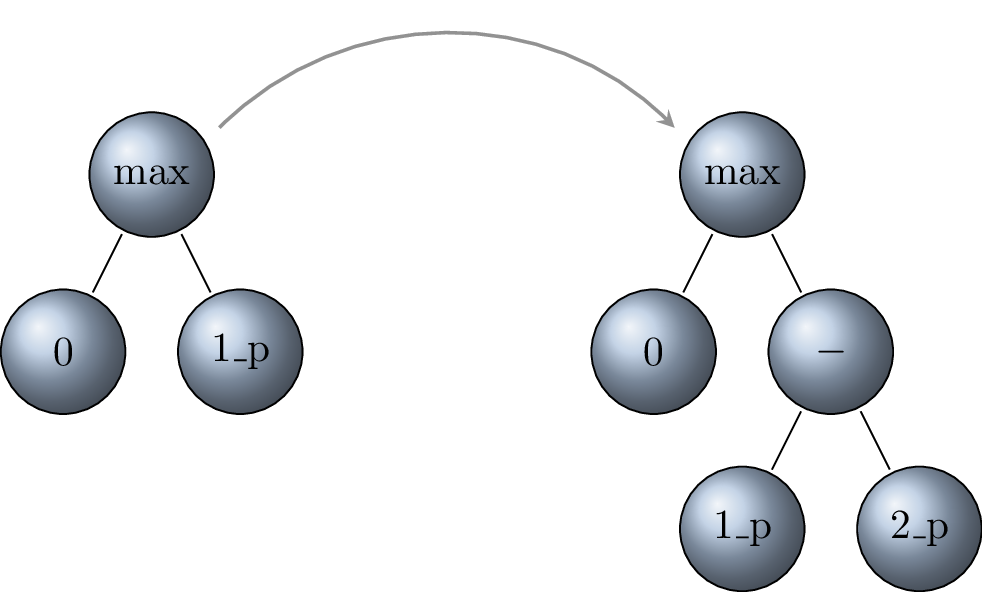
Calling a lazy bind expression with lazy arguments results in a new bind expression where placeholders in the former have been substituted by the lazy arguments. This is called reseating.
Assume that we have defined a lazy maximum function as described above.
auto ramp = via::max(0, 1_p);

// becomes (via argument-dependent lookup)
auto ramp = lazy::max(0, 1_p);

// which becomes
auto ramp = bind(via::max, 0, 1_p);
Notice how the lazy evaluation of via::max results in a bind expression that
uses via::max.
This enables reseating.
|
| Extending at placeholder |
We can combine expressions into larger expressions.
For example, calling the above ramp expression with a bind expression as argument gives
us a reseated bind expression.
auto ramp_diff = ramp(1_p - 2_p);

// becomes
auto ramp_diff = bind(via::max, 0, 1_p)(1_p - 2_p);

// which becomes (via reseating)
//   1_p is substituted with 1_p - 2_p
auto ramp_diff = bind(via::max, 0, 1_p - 2_p);
Reseating gives us the ability to construct new expressions by calling lazy bind expressions with lazy arguments. Extending lazy bind expressions via reseating only works at placeholder nodes though.
Invoking lazy bind expressions with eager arguments causes an eager evaluation of the expression. This is what we ultimately want to use bind expressions for.
 |
| Contracting eager sub-expression |
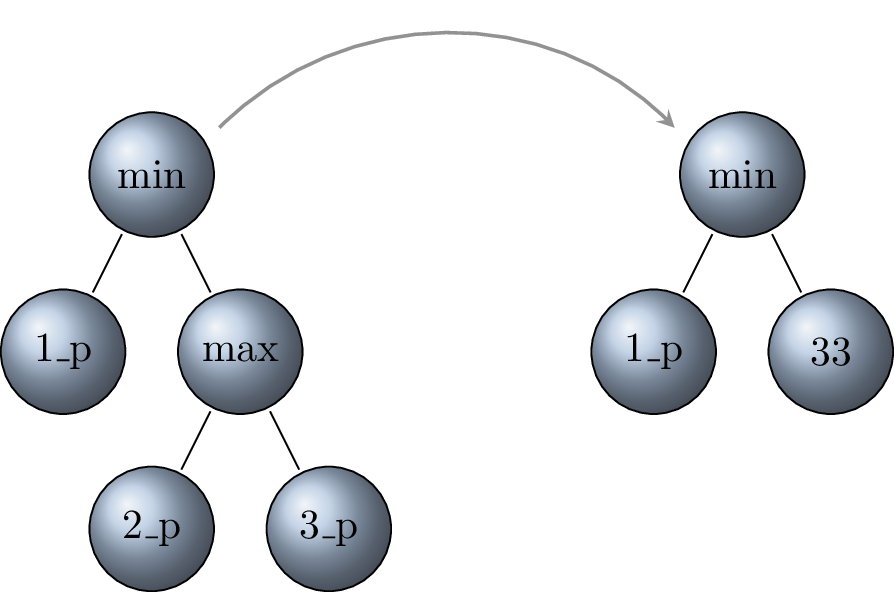
This also works for sub-expressions. If a sub-expression only contains eager arguments, then that sub-expression is evaluated eagerly and the result replaces the sub-expression.
auto f = via::min(1_p, via::max(2_p, 3_p));

// becomes
auto f = bind(via::min, 1_p, bind(via::max, 2_p, 3_p));
auto g = f(1_p, 22, 33);
// becomes
auto g = bind(via::min, 1_p, via::max(22, 33));
// which becomes (via eager evaluation)
auto g = bind(via::min, 1_p, 33);This gives us the ability contract some parts of lazy bind expressions.